Letters That Landed
A constituent wrote her congressman about disaster mortgage relief. Most people get a form letter back. She didn't.

Most of us, when we write our member of Congress, don’t really expect a response. At least not a personalized, meaningful response.
If we get one at all, we expect what almost everyone gets: a form letter. Three paragraphs that thank you for reaching out, reaffirm the member’s commitment to representing the district, and somehow manage not to say what the member actually thinks about the thing you asked about. The civic-mail equivalent of an out-of-office reply.
So when a partner forwarded me a response her friend received last week, I sat with it for a minute.
The constituent used CivIQ to write her representative about disaster mortgage relief. She’s part of a coalition called Disaster Mortgage Relief, led by people whose own communities were destroyed by the LA wildfires, advocating for two specific federal fixes for families whose homes were destroyed or made uninhabitable by federally declared disasters: extending forbearance to match real rebuild timelines, which can run two to three years and longer, and moving deferred payments to the end of the loan rather than dropping them on survivors as a lump sum.
In less than 60 seconds, she used CivIQ to make common-sense requests based on her own lived experience. The survivors are real. The current system charges people interest on mortgages for homes that no longer exist.
She wrote her message. She sent it. She didn’t expect much.
What came back was not a form letter.
Her representative, Congressman Hank Johnson, wrote back on official letterhead and engaged deeply with the substance. He agreed that disaster survivors deserve more forbearance assistance than the current system provides. He took a position. On his own stationery. To one constituent.
That should not be remarkable. It is.
I am going to spend a lot of this newsletter writing about voices going into Washington… what constituents say, how they say it, what changes when the infrastructure for being heard actually works. But every once in a while, the loop closes in a meaningful way. A response written by a person, in a position taken with care, on letterhead with a real name at the bottom.
That deserves notice.
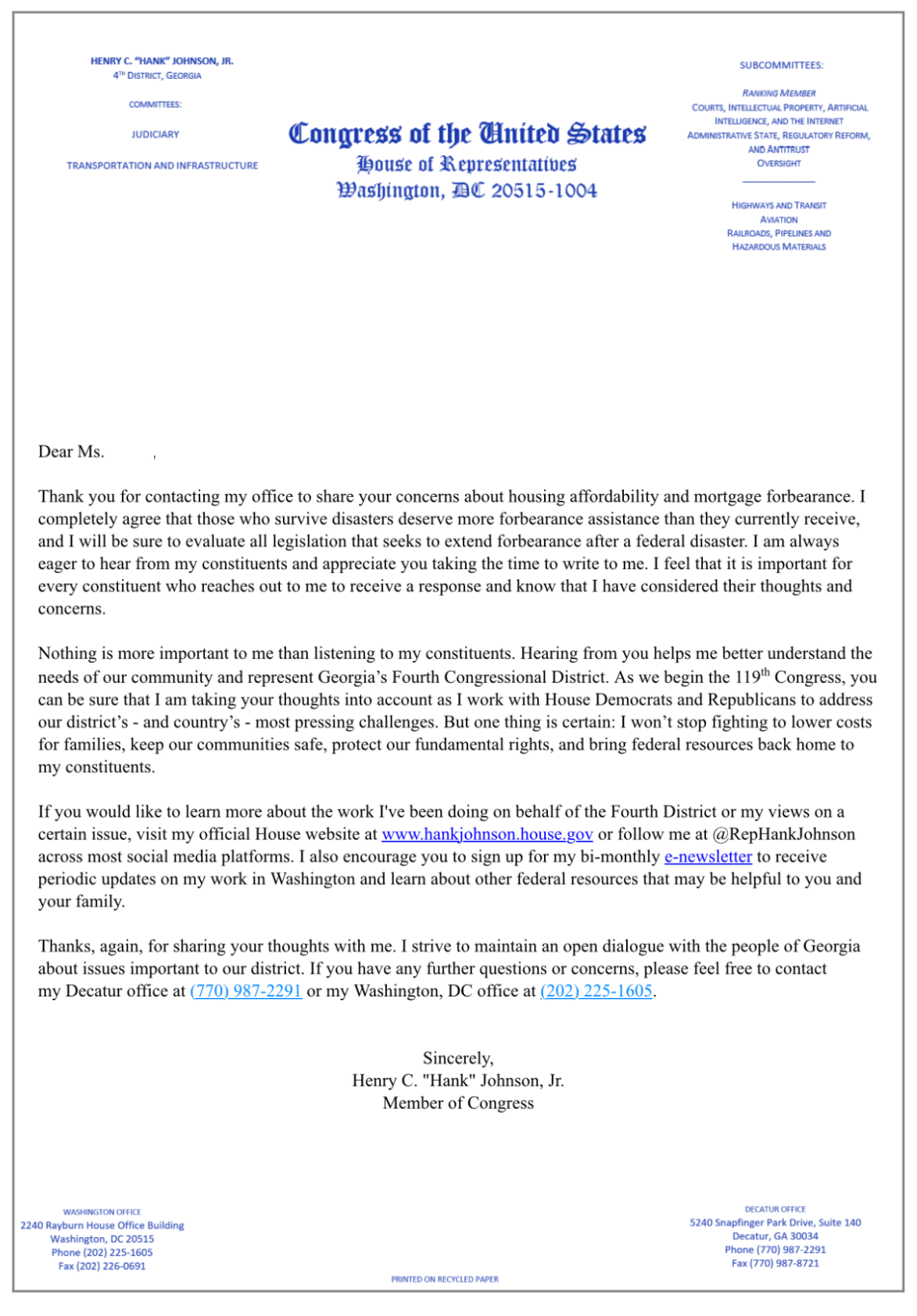
Offices that read carefully enough to see what one constituent actually said and write back in a way that honors it deserve to be recognized. The thing the role is actually for.
So: thank you to Congressman Hank Johnson and his team. Not for agreeing with the policy ask, necessarily. Plenty of members will disagree with this constituent’s view, and that is how a republic works. The thank-you is for answering. For treating a constituent message like the start of a conversation, not a piece of mail to dispose of.
I’d love to feature more of these from any office, any district, any side of any issue. If you’ve ever sent a message through CivIQ, or anywhere else, and gotten back a response that actually engaged, hit reply or send it to me. I’m building a small archive of what responsive looks like when it shows up. The point isn’t to shame anyone for what they didn’t write. It’s to make sure we notice - out loud, in public - when an office gets it right.
That’s what landed this week.
Aubrey